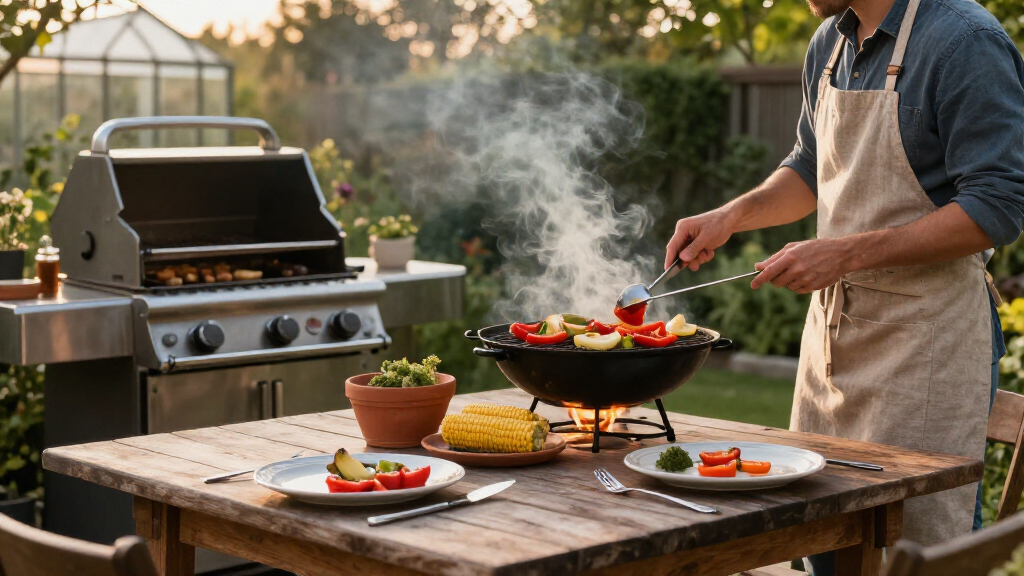

Choosing an outdoor kitchen grill is partly a choice about how permanent the cooking area should be. Built-in grills sit inside a counter or purpose-built island, creating a continuous work surface and a fixed place for cooking. Freestanding grills arrive on a cart or stand, so they can work on a patio without a custom kitchen and can be repositioned when plans change.

Get garden gear delivered free with Prime
- Fast, free delivery on millions of items
- Prime Video, Amazon Music and more included
- Member-only deals all year

Brand-Man 40-Inch Built-In 6-Burner Gas Grill Head
- ✔ Fuel: Liquid propane; convertible to natural gas with separate kit
- ✔ Burners: 6 stainless steel burners
- ✔ Total burner output: 60,000 BTU

Brand-Man 6-Burner Outdoor Gas Grill Island with Side Burner
- ✔ Fuel: LPG; convertible to natural gas with optional kit
- ✔ Main burners: 6 stainless steel burners, 10,000 BTU each
- ✔ Side burner: 1 burner, 12,000 BTU

SPIRE 30-Inch Built-In 5-Burner Gas Grill with Rear Burner
- ✔ Fuel: Gas; subtype not specified
- ✔ Main burners: 5 at 10,000 BTU each
- ✔ Rear burner: 13,000 BTU
The main tradeoff is integration versus flexibility. A built-in model can make a carefully planned outdoor kitchen feel more cohesive, but the island, utility connections, and installation add cost and complexity. A freestanding grill is usually the more practical starting point and can still deliver strong everyday cooking, though it takes up more visible floor space and may offer less counter-side convenience. Choose built-in if you expect the kitchen layout to stay put and will use its integrated work area; choose freestanding if budget, mobility, or a simpler setup matters more.
At a Glance
| Criteria | Built-in outdoor kitchen grills | Freestanding outdoor kitchen grills | Winner |
|---|---|---|---|
| Upfront cost | Higher once the grill, island, countertop, and installation are included | Usually lower to get cooking; no custom island is required | B |
| Installation | Needs a compatible island or counter opening; gas and electrical work may need planning | Often simpler; some models need only assembly and a suitable fuel connection | B |
| Layout and mobility | Fixed in place after installation | Can usually be rolled or moved; certain models are easier to store | B |
| Cooking capability | Depends on the model; built-in format alone does not guarantee better heat or results | Ranges from basic to high-end, with many sizes and configurations | Depends |
| Workspace and integration | Strong integration with counters, storage, and other outdoor kitchen features | Cart provides a ready base, but the unit occupies floor space and gives less surrounding counter area | A |
| Maintenance and replacement | Access and replacement can be more involved because the grill is fitted into the structure | Often easier to access, replace, or relocate as a complete unit | B |
| Long-term value | Best when the permanent kitchen will see frequent use and the whole setup is well planned | Strong for flexible patios, uncertain plans, or buyers who want to spend more on the grill itself | Depends |
Brand-Man 40-Inch Built-In 6-Burner Gas Grill Head
For a permanent outdoor counter, this is the most complete built-in cooking setup in the group. Its 860 square inches of stated cooking space includes a 620-square-inch primary area and a substantial 240-square-inch warming rack, giving us room to cook and hold food separately. Six burners support multi-zone cooking, while the included cast iron grates and griddle plate let us choose between conventional grilling and a flat surface without sourcing a separate accessory.Compared with the SPIRE, the Brand-Man prioritizes a wider built-in cooking station and mixed cooking surfaces over a dedicated rear burner. The SPIRE may suit us better if rotisserie cooking is central or if a narrower grill head fits our counter plan. Against the Brand-Man island, this grill head offers a more integrated counter approach, but no included cabinet, wheels or side burner. Its double-walled hood and slide-out grease tray add practical touches for heat retention and cleanup.The tradeoff is planning: the specified cutout is about 40.5–42.8 inches wide, so we need to confirm the counter opening before buying. It runs on liquid propane as supplied, and natural gas conversion calls for a separately sold kit. This is our strongest all-around built-in pick when the larger opening and fuel arrangement suit the outdoor kitchen.
Pros:
- Six burners support cooking across multiple heat zones.
- Large stated cooking area includes a 240-square-inch warming rack.
- Cast iron grates and a griddle plate provide two cooking surface styles.
- Double-walled hood and slide-out grease tray support heat retention and cleanup.
Cons:
- Requires a built-in cutout within the specified width and depth range.
- Natural gas conversion kit is sold separately.
Best for: Home cooks planning a broad built-in counter who want six burner zones, a griddle surface and a warming rack.
Not ideal for: Buyers with a compact counter opening, those who want a mobile grill island, or anyone who needs natural gas compatibility without a separate conversion kit.
Bottom line: We recommend this as the most versatile built-in choice when our counter can accommodate its cutout and we value a griddle alongside the main grill.
“We recommend this as the most versatile built-in choice when our counter can accommodate its cutout and we value a griddle alongside the main grill.”
Brand-Man 6-Burner Outdoor Gas Grill Island with Side Burner
When we want a cooking station that arrives with its own base, the Brand-Man island is the most self-contained option here. Six 10,000 BTU main burners provide the primary grilling setup, and a 12,000 BTU side burner gives us a place to prepare a sauce or side dish while the main grates are occupied. The package also includes a griddle plate, cast iron grates, warming rack and enclosed storage cabinet, combining more functions than either built-in head.Its 871-square-inch total area is the largest stated figure in this lineup, though 247 square inches belong to the warming rack and 624 to the main cooking area. Compared with the 40-inch built-in, the island trades a fixed counter installation for wheels, storage and a side burner. Compared with the SPIRE, it offers substantially more included station features, but it does not list a rear burner for rotisserie cooking.The island’s eight wheels, including two lockable swivel casters, help with positioning and parking. Still, at 67.5 inches wide and 163.1 pounds, it needs generous patio space and is not a lightweight unit to move around casually. It uses LPG, with a separately sold natural gas conversion kit, and arrives in two boxes. Choose it when we want a full mobile station and have room for its footprint.
Pros:
- Six main burners plus a side burner support varied outdoor cooking tasks.
- Includes cast iron grates, a griddle plate, warming rack and storage cabinet.
- Wheels and lockable swivel casters help with repositioning and parking.
- Full-size slide-out grease tray makes cleanup more accessible.
Cons:
- Its 67.5-inch width and 163.1-pound weight require substantial space and careful placement.
- Natural gas conversion kit is sold separately.
- The grill arrives in two separate boxes.
Best for: Patio cooks who want a grill, side burner, storage and movable island base in one setup.
Not ideal for: Buyers seeking a compact built-in grill head, a lighter unit, or a dedicated rear burner for rotisserie cooking.
Bottom line: We choose this island when an all-in-one, movable cooking station matters more than a built-in counter fit or a compact footprint.
“We choose this island when an all-in-one, movable cooking station matters more than a built-in counter fit or a compact footprint.”
SPIRE 30-Inch Built-In 5-Burner Gas Grill with Rear Burner
The SPIRE earns its place by pairing a relatively compact built-in format with a feature the other two lack: a 13,000 BTU rear burner. That burner supports rotisserie cooking or warming, adding a cooking method beyond the five 10,000 BTU main burners. Its 750-square-inch cooking surface is generous for this 30-inch model, so we can handle several dishes without moving up to the broader Brand-Man built-in head.Compared with the Brand-Man 40-Inch, the SPIRE gives up one main burner, the included griddle plate and the larger stated area, but gains a dedicated rear burner and a narrower nominal format. That can make it a better match for a more constrained built-in plan or a household that specifically wants rotisserie capability. The island has storage, wheels and a side burner that this grill head does not, so it remains the better choice when we need a complete station rather than an insert.A stainless steel frame and 304 stainless steel cooking grates are designed for durability and straightforward cleanup. The removable grease tray and electronic ignition add convenience, while the 121-pound weight is a reminder that built-in installation still takes planning and handling. The supplied details identify it as gas but do not specify a fuel subtype or conversion path, so we should confirm compatibility with our intended supply before committing.
Pros:
- Dedicated 13,000 BTU rear burner supports rotisserie cooking or warming.
- Five main burners provide 50,000 BTU of main cooking output.
- 304 stainless steel grates and stainless steel frame are designed for durability.
- 750-square-inch cooking surface pairs with a removable grease tray and electronic ignition.
Cons:
- Built-in configuration limits placement and requires a suitable counter installation.
- At 121 pounds, it needs careful handling during installation.
- Fuel subtype and conversion details are not specified in the supplied product information.
Best for: Outdoor kitchen planners who want a 30-inch built-in grill with a rear burner for rotisserie cooking or warming.
Not ideal for: Buyers who want an included griddle plate, the broadest cooking surface, a side burner or a complete wheeled island.
Bottom line: We recommend the SPIRE when a rear burner and a smaller built-in format matter more than the larger area and griddle included with the Brand-Man grill head.
“We recommend the SPIRE when a rear burner and a smaller built-in format matter more than the larger area and griddle included with the Brand-Man grill head.”
As an Amazon Associate we earn from qualifying purchases.
Key Differences
The format affects the whole cooking area, not just where the grill sits. A built-in grill makes sense when the island is part of a larger plan for counters, storage, and possibly a sink or refrigerator. Those features can make preparation and serving easier, but they require space, installation planning, and a budget for the structure around the grill. If the kitchen is likely to remain in one place and gets frequent use, that integration can be valuable.
A freestanding grill keeps the decision narrower: buy the grill, give it a safe and suitable place, and add work surfaces or storage if needed. That usually lowers the initial commitment and makes future changes easier. It does not mean a freestanding model must be basic; high-end carts can offer substantial cooking capacity and features. Since performance depends on the particular grill rather than its mounting style, compare burner layout, cooking area, fuel, and construction separately.
The practical dividing line is how much certainty you have about the outdoor kitchen. Built-in is a better fit for a settled layout and a buyer who will use the surrounding workspace enough to justify its cost. Freestanding is the stronger default for most patios, especially when the budget is limited, the space serves several purposes, or the owner may move. Paying more for a built-in setup is worthwhile when integration is part of the plan, not simply because a fixed grill looks more substantial.
Detailed Comparison
Upfront cost (Freestanding outdoor kitchen grills wins — major)
Freestanding wins by a major margin for getting started: its cart is part of the unit, so there is no custom island bill. Built-in cost includes the grill plus an appropriate structure, countertop, and potentially professional installation or utility work. The real comparison is the cost of complete, usable stations, not just the grill models. Choose built-in when the added kitchen features are part of the value you want; choose freestanding when you would rather put that money toward a better grill or other patio needs.
Installation (Freestanding outdoor kitchen grills wins — moderate)
Freestanding usually wins by a moderate margin because setup can be limited to assembly and a safe placement, depending on fuel type and local requirements. Built-in needs a correctly sized opening, suitable clearances, and a structure designed for the grill; gas and electrical connections may call for qualified work. A well-planned installation can produce a polished result, but a poor fit can be costly to fix. Buyers planning a full outdoor kitchen may accept this effort as part of the project.
Layout and mobility (Freestanding outdoor kitchen grills wins — major)
Freestanding wins by a major margin for flexibility. Many cart models can be rolled across a patio, repositioned for gatherings, or replaced without rebuilding a counter. Built-in grills are fixed once installed, which benefits a stable kitchen layout but limits changes later. Mobility varies by model, and moving a connected grill still requires care, but the cart format remains the better choice for renters, frequent rearrangers, and anyone unsure about the final location.
Cooking capability (minor difference)
There is no format winner; the difference is minor compared with the specifications of the individual grill. Both built-in and freestanding products can be designed for different cooking areas, burner counts, and fuel types. A fixed installation does not automatically mean higher heat, more even cooking, or better food. Compare the cooking surface, burner arrangement, temperature control, fuel compatibility, and replacement parts. Spend more for cooking features you will use, not for the mounting style alone.
Workspace and integration (Built-in outdoor kitchen grills wins — moderate)
Built-in wins by a moderate to major margin when it is installed as part of a usable island. It can place counter space beside the grill and connect cooking with storage or other appliances, reducing trips back indoors and giving guests a clearer serving area. A freestanding cart provides a base and may include shelves, but it usually cannot provide the same continuous work surface. The advantage depends on the complete layout: a built-in grill without useful nearby counter space offers less practical benefit.
Maintenance and replacement (Freestanding outdoor kitchen grills wins — moderate)
Freestanding wins by a moderate margin for access and replacement. The grill can generally be reached as a unit, and a new one can take its place without altering an island. Built-in models are accessible for routine cleaning, but repairs or eventual replacement can require working around the surrounding structure and checking that a new model fits the opening. Buyers who expect to upgrade often or want to avoid tying the kitchen to one grill size should favor freestanding.
Long-term value (moderate difference)
This is a genuine tie because value depends on use and plans. A built-in setup earns its higher cost when frequent cooking, integrated preparation space, and a settled layout make the whole kitchen useful. A freestanding model delivers better value when a buyer wants reliable grilling without paying for permanent construction, or when future moves are possible. Neither format guarantees a resale return. Judge the premium by the years of added convenience you expect to get from the complete installation.
Built-in outdoor kitchen grills: Pros and Cons
Pros:
- Creates a cohesive cooking station with a continuous counter or island
- Can integrate storage and other outdoor kitchen features
- Keeps the grill in a fixed, planned location
Cons:
- Costs more once the island and installation are included
- Requires careful sizing, clearances, and utility planning
- Harder to move, change, or replace without affecting the surrounding structure
Freestanding outdoor kitchen grills: Pros and Cons
Pros:
- Lower-commitment setup with no custom island required
- Easier to move, reposition, or replace as plans change
- Available across a wide range of sizes, features, and budgets
Cons:
- Uses patio floor space for its cart
- Usually offers less continuous counter and storage integration
- May feel less cohesive in a fully built-out outdoor kitchen
Who Should Choose What
Choose Built-in outdoor kitchen grills if:
- You are building a permanent outdoor kitchen with counter space and storage
- The grill will stay in one location and see frequent use
- You value a unified cooking and serving area enough to pay for the island and installation
Choose Freestanding outdoor kitchen grills if:
- You want a capable grill without committing to custom construction
- You may move, rearrange the patio, or upgrade the grill later
- Your budget is better spent on grill features or other outdoor needs
Skip both if: Neither format fits a space that cannot provide safe clearance, suitable ventilation, and an appropriate fuel setup; solve the site constraints before choosing a grill.
Value for Money
Freestanding is the better value for most buyers who simply want to cook outdoors. Its lower setup cost leaves more room in the budget for a larger cooking surface, useful accessories, or a higher-quality grill, and the whole unit is easier to change later. Built-in becomes worth paying more for when the island itself adds daily convenience: nearby preparation space, storage, and a permanent layout that supports how you host and cook.
Compare complete installations. A built-in grill price alone can make the project seem closer in cost than it will be after adding the counter and required work. Conversely, a freestanding grill may need separate tables or storage to provide the workspace you want. Pay the premium for a built-in kitchen when you will use those features often and expect the location to remain stable. If those conditions are uncertain, freestanding protects flexibility and usually delivers more value.
Final Verdict
For most buyers, a freestanding outdoor kitchen grill is the better starting choice: it costs less to set up, offers broad model choice, and is easier to move or replace. Choose it if the priority is dependable grilling without a permanent construction project. Choose a built-in grill if you are already committing to a fixed outdoor kitchen and will make regular use of its integrated counter, storage, and serving area.
The biggest deciding factor is whether you want to invest in the kitchen around the grill, not whether a built-in model is inherently a better cooker. Pay more for built-in when permanence and workspace improve your routine. Otherwise, buy the freestanding grill that best matches your cooking needs and keep the patio adaptable.
Frequently Asked Questions
Does a built-in grill cook better than a freestanding grill?
Not by virtue of being built in. Cooking results depend on the particular grill’s burner design, heat control, cooking area, and fuel. Compare those features directly across models.
Is a built-in outdoor grill worth the extra cost?
It can be worth it if you are building a permanent kitchen and will use the surrounding counter and storage often. If you mainly need a grill, a freestanding model usually offers better value.
Can I put a freestanding grill in an outdoor kitchen?
Often, yes, if the layout leaves the clearances and access the grill requires. Check the manufacturer’s instructions and plan for safe placement, ventilation, and fuel connections before fitting it into cabinetry.
Which type is easier to replace?
A freestanding grill is generally easier to replace because it is not fitted into a fixed opening. A built-in replacement needs to match the island cutout or require changes to the surrounding structure.
Evergreen bestsellers Picks

KitchenAid Artisan 5-Quart Tilt-Head Stand Mixer, Almond Cream

Breville Barista Express Espresso Machine with Built-In Grinder, Black Sesame

Samsung 43-Inch M70H Series 4K Mini LED Smart TV (2026)
As an affiliate, we earn on qualifying purchases.