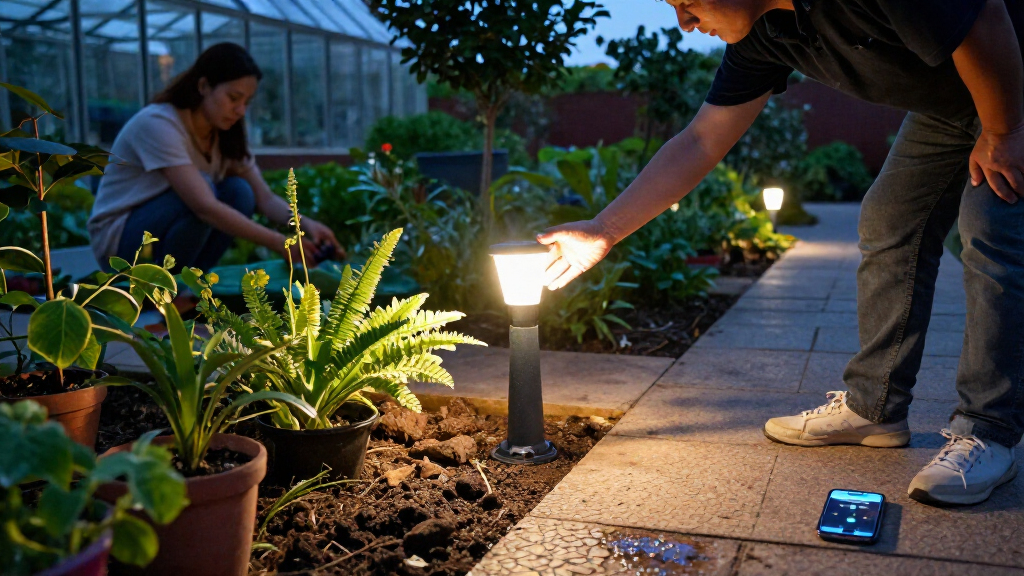
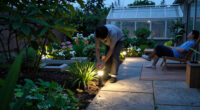
Outdoor smart lighting buyers often face a choice between building a dependable home lighting system and getting bold color effects across a larger area for less. Philips Hue and Govee represent those two approaches. Hue is designed to fit into a broader, coordinated lighting ecosystem, with outdoor fixtures that can work alongside indoor lights and smart home routines. Govee puts more emphasis on accessible RGB effects and feature-rich products at lower prices.

Get garden gear delivered free with Prime
- Fast, free delivery on millions of items
- Prime Video, Amazon Music and more included
- Member-only deals all year

Govee Permanent Outdoor Lights 2 Pro, 200 ft
- ✔ Length: 200 ft
- ✔ Color effects: Multicolor, customizable dual-zone
- ✔ White-light range: 1000K–10000K

Govee Permanent Outdoor Lights Pro, 200 ft, 120 RGBIC LEDs
- ✔ Length: 200 ft
- ✔ LED count: 120 RGBIC LEDs
- ✔ White-light range: 2700K–6500K

Govee Permanent Outdoor Lights 2, 100 ft RGBIC Smart Lights
- ✔ Length: 100 ft
- ✔ Lighting: RGBIC; 16 million colors; 100 scene modes
- ✔ White brightness: 45 lumens
The difference matters after installation: Hue tends to make more sense when outdoor lights need to respond reliably as part of daily routines, while Govee can be a better fit for patios, rooflines, and entertaining spaces where dramatic scenes matter most. The right choice depends on whether you value ecosystem integration and consistency enough to pay more, or would rather stretch your budget across more visible lighting.
At a Glance
| Criteria | Philips Hue | Govee | Winner |
|---|---|---|---|
| Purchase cost and value | Premium pricing; value improves when used with other Hue lights | Usually lower-cost, making larger installations more affordable | B |
| Smart home integration | Broad ecosystem support, with features varying by product and setup | App and voice control options vary by product; check compatibility before buying | A |
| Lighting effects | Good color scenes and coordinated lighting | Wide range of animated RGB effects and scene options | B |
| Product range and coverage | Outdoor fixtures across several categories, generally at higher cost | Many formats, including accent and perimeter lighting; selection changes by market | Depends |
| Everyday control | Polished app and routines suited to regular use | Feature-rich app controls, though the experience can vary by product | A |
| Installation and setup | May require a Hue Bridge for full features; plan placement and power | Often straightforward, but permanent outdoor installation still needs weather-safe planning | Depends |
| Long-term system fit | Strong fit for a home already invested in Hue | Good fit for effects-focused expansions that do not need to join a Hue system | Depends |
Govee Permanent Outdoor Lights 2 Pro, 200 ft
For buyers choosing a permanent system around a varied roofline, the Outdoor Lights 2 Pro makes the strongest all-around case. Its snap-fit connectors and cut-or-extend design give us more ways to handle different run lengths than the fixed 100 ft Lights 2, while its dual-zone colors can create separate color effects across a light rather than a single uniform look. That distinction matters when we want the roofline to feel more tailored than a basic multicolor strip.The 1000K–10000K white-light range also stretches from very warm to very cool, giving this system broader white-light choices than the standard 200 ft Pro’s 2700K–6500K range. Matter, Alexa, and Google Assistant support suit homes that already use voice control or automation, and the stated operating range of -22°F to 140°F is the broadest cold-weather specification among these three. The tradeoff is that it remains a corded plastic system, with 40 lumens listed for brightness. Buyers who mainly want a longer, cuttable system with a specified 50 lumens per light may prefer the standard 200 ft Pro; those who do not need installation flexibility may find the 100 ft model simpler.
Pros:
- Cut-or-extend design and snap-fit connectors support varied roofline layouts.
- Dual-zone color effects offer more tailored scenes than a single-zone approach.
- 1000K–10000K range covers very warm through very cool white light.
- Matter, Alexa, and Google Assistant support voice control and automations.
Cons:
- Requires corded electric power and a suitable outdoor power setup.
- Plastic construction may not suit buyers seeking metal fixtures.
- Listed brightness is 40 lumens.
Best for: Homeowners planning a permanent 200 ft roofline who want flexible fitting, dual-zone effects, and a broad choice of white light.
Not ideal for: Buyers who need a cordless system, want a brighter stated per-light specification, or have a fixed short run that does not need a 200 ft kit.
Bottom line: Choose the Lights 2 Pro when adaptable installation and broad color and white-light control matter more than a higher listed per-light brightness.
“Choose the Lights 2 Pro when adaptable installation and broad color and white-light control matter more than a higher listed per-light brightness.”
Govee Permanent Outdoor Lights Pro, 200 ft, 120 RGBIC LEDs
The standard 200 ft Permanent Outdoor Lights Pro is a strong choice when our priority is a long, configurable run with recognizable smart home support. It combines RGBIC effects with adjustable 2700K–6500K white light, so we can use warm tones for a softer evening look and cooler white for a different setting. Matter support joins Alexa and Google Assistant, making it a better fit for a mixed smart home than the 100 ft Lights 2, which lists Alexa and Google Assistant but not Matter.Unlike that 100 ft system, this Pro model can be cut and spliced according to its manual, helping us adapt the run to a measured layout. It lists up to 50 lumens per light and 75 scene modes. Its compromises are practical: the adapter is intended for indoor use, so the power connection needs a covered GFCI receptacle and weatherproof enclosure, and the lights must sit 2–4 inches from the wall. It also cannot be spliced with the 100 ft or 150 ft Pro versions or certain separately sold accessories. Compared with the Outdoor Lights 2 Pro, it has a narrower white range and lacks the stated dual-zone feature, but its specified per-light brightness is higher.
Pros:
- Cut-and-splice design can adapt the run to the installation when used as directed.
- Matter, Alexa, and Google Assistant support connected-home control.
- 2700K–6500K white range complements RGBIC color effects.
- Lists up to 50 lumens per light and 75 scene modes.
Cons:
- Adapter is intended for indoor use; the outdoor receptacle needs appropriate cover and enclosure.
- Not compatible for splicing with the 100 ft or 150 ft Pro versions or certain accessories.
- Installation calls for placing lights 2–4 inches from the wall.
Best for: Buyers with a long roofline who want cut-and-splice flexibility, Matter control, and tunable warm-to-cool white light.
Not ideal for: Anyone who needs an adapter designed for outdoor exposure, wants to mix Pro lengths, or cannot position lights 2–4 inches from the wall.
Bottom line: Pick this 200 ft Pro when a configurable long run and Matter support are priorities and its adapter and spacing requirements fit the site.
“Pick this 200 ft Pro when a configurable long run and Matter support are priorities and its adapter and spacing requirements fit the site.”
Govee Permanent Outdoor Lights 2, 100 ft RGBIC Smart Lights
When we have a shorter roofline and can measure it accurately before installation, the 100 ft Outdoor Lights 2 offers a simpler fixed-length route to permanent color lighting. Its RGBIC LEDs provide multicolor effects, while the app adds timers, scene modes, and AI-generated effects. Alexa and Google Assistant support cover common voice-control needs. For a buyer who wants those features across a modest, planned run, the 100 ft format avoids choosing a 200 ft kit simply for its extra length.The important limitation is that these lights cannot be cut. That makes layout measurement more consequential than with either 200 ft Pro option, both of which allow some form of cutting or adjustment. Its product description lists 100 scene modes, more than the standard 200 ft Pro’s 75, but a larger scene count does not make up for a length mismatch. Installation hardware includes adhesive, clips, screws, and adapter buckles; the lights are rated IP67 and the control box IP65. We still need a covered Class A GFCI receptacle with a weatherproof enclosure. Compared with the Pro models, this is the more limited fit for custom layouts and Matter-based homes, but it remains the most directly sized option for a fixed 100 ft run.
Pros:
- 100 ft length is suited to a shorter planned roofline.
- RGBIC lighting offers 16 million colors and 100 scene modes.
- Includes adhesive, clips, screws, and adapter buckles for installation.
- App timers and Alexa or Google Assistant control add scheduling and voice options.
Cons:
- Lights cannot be cut to fit a shorter installation.
- Requires a covered Class A GFCI receptacle with a weatherproof enclosure.
- Installation has limits on segments and extension cables.
Best for: Buyers with a measured run of up to 100 ft who want app scenes, timers, and Alexa or Google Assistant control.
Not ideal for: Anyone whose roofline needs a shorter cut-to-fit layout, a run beyond the kit’s supported limits, or Matter integration.
Bottom line: Choose the 100 ft Lights 2 for a measured, fixed-length run when its lack of cut-to-fit flexibility is acceptable.
“Choose the 100 ft Lights 2 for a measured, fixed-length run when its lack of cut-to-fit flexibility is acceptable.”
As an Amazon Associate we earn from qualifying purchases.
Key Differences
The clearest divide is system behavior versus spectacle per dollar. Hue earns its premium when outdoor lights are part of a whole-home setup: shared routines, familiar controls, and coordinated scenes can make a front path, porch, and living room feel like parts of one system. For a household already using Hue, adding outdoor fixtures is simpler to justify than starting from scratch. Buyers should still check the features supported by each specific fixture and any bridge or platform requirements.
Govee is more compelling when the goal is to transform a particular space with color, animation, or perimeter coverage without spending as much. Its products often emphasize visual variety and app effects. That can make a patio or holiday display feel more expressive for the budget. The tradeoff is that product-by-product compatibility and control can matter more; buyers should confirm that a particular model works with their preferred voice assistant and routines before committing.
Neither brand wins every installation. A few lights on a daily-use entryway benefit more from predictable routines and integration than from dozens of color modes. A long roofline or party area may reward Govee’s lower cost and effects more than a unified lighting ecosystem. Compare the actual fixtures, power and mounting needs, weather ratings, and control requirements—not just brand names.
Detailed Comparison
Purchase cost and value (Govee wins — major)
Govee usually wins on upfront cost, so it can cover more of a yard or roofline at the same budget. Hue costs more, but the premium can pay back in convenience for existing Hue households that want outdoor fixtures controlled alongside their current lights. For a standalone decorative installation, the extra Hue spend is harder to justify.
Smart home integration (Philips Hue wins — moderate)
Hue has the advantage for buyers who want lighting to behave as one coordinated system across indoor and outdoor areas. Govee offers smart controls too, but compatibility and automation support can vary by product. This is a moderate-to-major difference for routine-driven homes and a minor one for lights mostly controlled through an app.
Lighting effects (Govee wins — moderate)
Govee generally offers a broader emphasis on animated color effects and scene variety, which gives it the edge for entertaining, seasonal displays, and expressive accent lighting. Hue also provides color scenes, but its advantage is coordination and consistency rather than sheer spectacle. The gap is major if effects are the main purpose and minor for simple warm-white lighting.
Product range and coverage (moderate difference)
Neither brand is an automatic winner because the best fit depends on the area and fixture type. Govee’s varied decorative formats can make broad accent coverage less expensive; Hue offers a cohesive lineup for buyers choosing several kinds of outdoor lights. Compare the exact models available in your market, their spacing, power needs, and whether they illuminate or merely accent the space.
Everyday control (Philips Hue wins — minor)
Hue has a modest edge for people who want dependable daily routines and controls that fit an established Hue setup. Govee’s app is appealing for adjusting scenes and effects, though the experience differs among products. The practical gap is minor for occasional use and more meaningful when household members need consistent controls every night.
Installation and setup (minor difference)
This is a close call. Some Govee products are designed for accessible DIY installation, while Hue installations may involve a Bridge and more deliberate ecosystem planning. Both still need careful attention to outdoor-rated power, mounting, cable runs, and placement. The product format and property layout matter more than the logo, so check the installation guide before buying.
Long-term system fit (major difference)
Hue wins if the plan is to expand a coordinated smart lighting system over time; Govee wins if the plan is to add standalone decorative zones at controlled cost. This is a major difference only when future expansion or shared automations are part of the purchase. For a single project, select the product that best meets its lighting and installation requirements.
Philips Hue: Pros and Cons
Pros:
- Strong fit with an existing Hue lighting setup
- Good choice for coordinated routines across indoor and outdoor areas
- Polished everyday controls and scene management
Cons:
- Higher upfront cost
- Some setups need a Hue Bridge for full capabilities
- May be more system than a simple decorative installation requires
Govee: Pros and Cons
Pros:
- Usually lower cost for larger decorative installations
- Strong emphasis on animated RGB effects and scene variety
- Useful range of formats for patios, accents, and rooflines
Cons:
- Compatibility and control features vary between products
- Less compelling when the priority is one unified lighting ecosystem
- Product selection and long-term availability can differ by market
Who Should Choose What
Choose Philips Hue if:
- You already use Hue and want outdoor lights in the same routines
- You prioritize reliable daily control over a large menu of effects
- You are building a coordinated system that may expand over time
Choose Govee if:
- You want colorful effects for entertaining or seasonal displays
- You need to cover a larger area while keeping upfront costs down
- You mainly control lights through a dedicated app and do not need deep integration
Skip both if: Skip both if you need basic outdoor illumination at the lowest possible cost; standard outdoor fixtures with a suitable timer or motion sensor may be a better fit.
Value for Money
Govee is generally the better value for buyers measuring how much decorative coverage and color variety they get per dollar. That does not automatically make it the better purchase: if outdoor lights need to work with indoor Hue routines every day, Hue’s higher price can buy a more coherent experience and save control friction. Pay more for Hue when integration and regular use matter. For a standalone accent project where visual impact is the priority, Govee is usually the more economical choice.
Final Verdict
For most buyers choosing outdoor smart lights as a decorative project, Govee is the stronger value: it offers an effects-first approach at a lower typical cost. Choose Philips Hue if you already rely on Hue indoors or want outdoor lighting to join consistent whole-home routines; in that case, paying more has a clear purpose. The biggest deciding factor is whether these lights must belong to a coordinated smart home system. If yes, buy Hue. If no, and color coverage matters most, start with Govee.
Frequently Asked Questions
Is Philips Hue worth the extra cost for outdoor lights?
It can be, especially when you already own Hue products and want shared scenes, routines, and controls. For a standalone decorative display, Govee often delivers more visual variety for less money.
Which brand is better for colorful patio or roofline effects?
Govee is often the better fit for effect-heavy installations because its product range emphasizes animated RGB scenes. Check the specific model’s weather rating, installation instructions, and control compatibility before ordering.
Can Govee and Philips Hue lights work together?
They may coexist in a home through compatible smart home platforms, but they do not become one native lighting system automatically. Confirm support for the exact products and automations you plan to use.
Do outdoor smart lights need a hub?
Requirements depend on the product. Some Hue features may require a Hue Bridge, while Govee models often emphasize app-based control. Check the product specifications for connectivity, remote access, and voice assistant support.