
To choose the right BTU output for your grill, consider your typical cooking needs and how often you grill. Small families or occasional use generally requires 10,000–20,000 BTUs, while larger gatherings or searing demand above 40,000 BTUs. Keep in mind that higher BTUs don’t always mean better performance and can lead to more fuel use. Understanding how factors like grill size and material influence BTU needs helps you find the best fit—more details can guide your decision further.
Key Takeaways
- Match BTU ratings to your typical cooking volume and frequency for optimal performance and fuel efficiency.
- Consider grill size and material, as they influence the necessary BTU output for even heating.
- For small meals or occasional use, 10,000–20,000 BTUs suffice; larger gatherings may need 40,000+ BTUs.
- Higher BTUs increase heat quickly but can lead to unnecessary fuel consumption if not needed.
- Balance your grilling needs with energy efficiency by selecting a BTU range that suits your cooking style.

Are you unsure how to pick the right BTU output for your grill? It’s a common question, especially when you want to make sure your grill performs well without wasting fuel. The key lies in understanding that BTU, or British Thermal Units, measures the heat output of your grill’s burners. But more isn’t always better. A higher BTU doesn’t necessarily mean better grilling if it compromises fuel efficiency or doesn’t match your grill material.
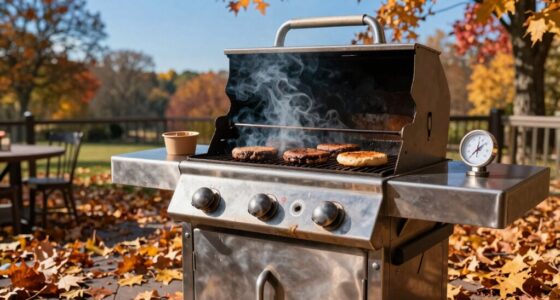
First, consider how much space you need to cover. If you’re only cooking for a small family or on occasional weekends, a grill with a lower BTU output—around 10,000 to 20,000 BTUs—should suffice. These models tend to be more fuel-efficient because they generate enough heat for most small to medium tasks without excessive fuel consumption. On the other hand, if you’re hosting large gatherings or want to sear steaks quickly, higher BTU ratings—above 40,000—might be appropriate. Just keep in mind that more BTUs often mean more fuel used, which can inflate your costs if the grill isn’t designed for fuel efficiency.
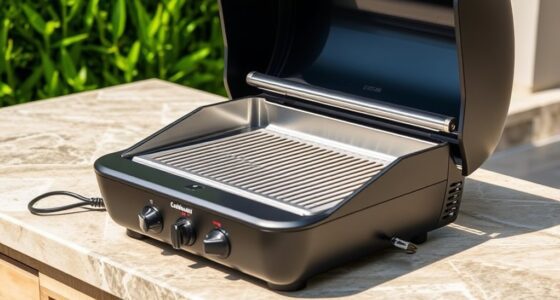
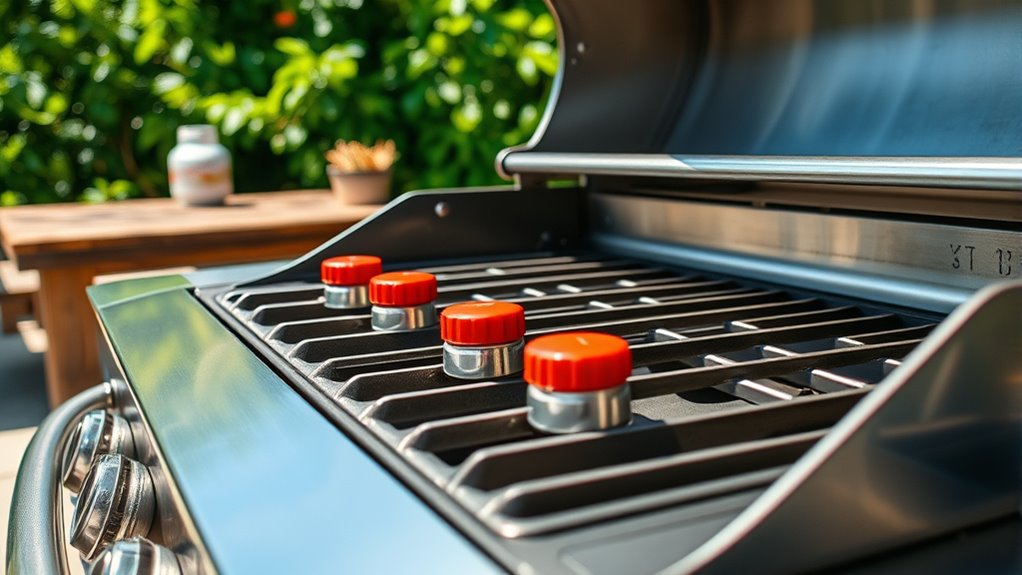
It’s also important to think about your grill’s material. Different materials retain and distribute heat differently, affecting how much BTU you actually need. For example, cast iron grates hold heat well and distribute it evenly, so you might get away with a slightly lower BTU rating without sacrificing performance. Meanwhile, stainless steel or aluminum grills can sometimes require higher BTU outputs to achieve the same level of heat because of their different heat conduction properties. When selecting your grill, match the BTU output to the grill material to optimize performance and fuel efficiency. A well-designed grill made from quality materials can often deliver excellent results with less fuel, making a lower BTU model more cost-effective and eco-friendly in the long run.
Additionally, considering the contrast ratio of your grill or cooking device can aid in understanding how well it will perform in different lighting or usage conditions. Ultimately, choosing the right BTU output isn’t just about going for the highest number. It’s about balancing heat needs with fuel efficiency and considering your grill’s material. Think about what and how often you cook, and match that to the heat capacity of your grill. A little research upfront helps you avoid wasting money on oversized, inefficient grills or underpowered models that don’t meet your needs. When you understand these factors, you’ll be better equipped to pick a grill that heats efficiently, saves fuel, and lasts longer, giving you perfect results every time you cook.

Royal Gourmet 8-Burner Gas Grill, 104,000 BTU Liquid Propane Grill, Independently Controlled Dual Systems, Outdoor Party or Backyard BBQ, Black
Spacious Cooking Surface and High Output: 993 sq. in. porcelain-enameled steel wire cooking grates are with food-grade treatment,…
As an affiliate, we earn on qualifying purchases.
As an affiliate, we earn on qualifying purchases.
Frequently Asked Questions
How Does Grill Size Influence BTU Requirements?
Your grill size directly impacts the BTU requirements because larger grill dimensions and greater cooking capacity demand more heat. A bigger grill needs higher BTU output to maintain consistent temperature across the surface, ensuring even cooking. When selecting a grill, consider how much space you need for your cooking capacity. If your grill is small, lower BTUs suffice, but larger models require higher BTU ratings to perform effectively.
Can Higher BTU Always Mean Better Grilling Performance?
Higher BTUs don’t always mean better grilling. While more BTUs can provide quicker heating, it’s essential to take into account your grill’s size, proper grill maintenance, and your preferred cooking techniques. An overly powerful grill might heat unevenly or waste fuel, so find a balance. Focus on maintaining your grill well and mastering cooking techniques to maximize performance, rather than just chasing higher BTU ratings for better results.
How Does Fuel Type Affect BTU Output?
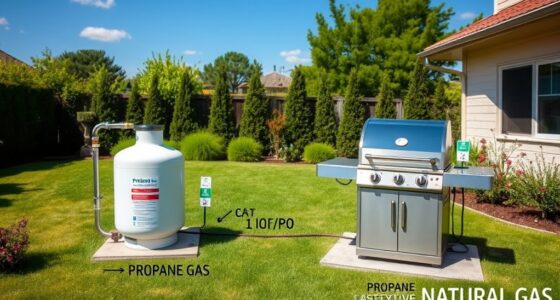
Fuel type dramatically impacts BTU output, transforming your grill into a roaring beast or a gentle flame. Propane burns hotter and more efficiently, giving you powerful heat with less fuel, thanks to premium ignition systems. Meanwhile, natural gas offers steady, consistent flames but usually needs higher BTU ratings to match propane’s fiery performance. Your choice affects fuel efficiency, heat control, and the overall grilling experience—so pick wisely!
Is a Higher BTU Grill More Energy-Efficient?
A higher BTU grill isn’t necessarily more energy-efficient. Your grill material, like stainless steel or cast iron, impacts heat retention and distribution, while your cooking techniques, such as indirect or direct grilling, influence fuel usage. Instead of focusing solely on BTU output, consider how well your grill maintains consistent heat and suits your cooking style. This approach helps you get better results without wasting energy.
What Safety Considerations Are Linked to High BTU Grills?
High BTU grills can pose safety risks if you don’t consider grill material and weather resistance. You should guarantee your grill’s material is durable and heat-resistant to prevent accidents like fires or damage. Also, if you use your grill outdoors, check its weather resistance to avoid electrical issues or rust. Always follow manufacturer safety instructions, keep a fire extinguisher nearby, and never leave high BTU grills unattended to stay safe.

Megamaster 1-Burner Portable Gas Grill with Locking Lid, 11,000 BTU Stainless Steel Burner, Foldable Legs, Small Propane Grill for Outdoor Cooking, Camping, BBQs, Patios, and Gardens – 820-0065C
【DURABLE STEEL CONSTRUCTION】Built with a heat-resistant finish, the tabletop grill's sturdy steel frame provides long-lasting protection against wear…
As an affiliate, we earn on qualifying purchases.
As an affiliate, we earn on qualifying purchases.
Conclusion
Choosing the right BTU output is like finding the perfect key to unseal your grilling potential. When you select a grill with the right power, you’ll turn simple ingredients into mouthwatering masterpieces. Don’t settle for just any flame; let it be your trusted compass guiding you to delicious success. Remember, the right BTU isn’t just about heat—it’s about igniting your passion and turning every cookout into a memorable celebration.
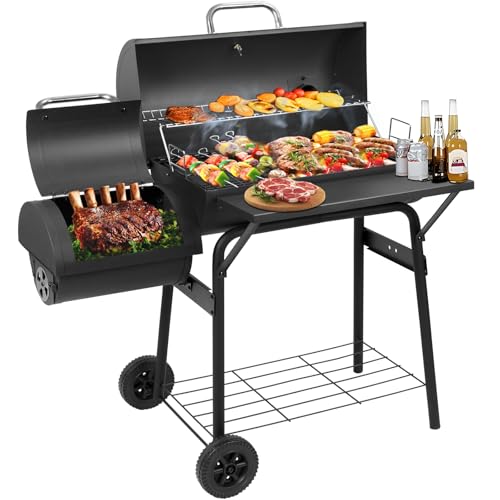
Charcoal Grill with Offset Smoker,BBQ Grills with Side Table,Outdoor Cooking with 535 Square Inches,Backyard Camping Picnics, Patio and Parties, Black by DNKMOR
[Sufficient Cooking Area]:This charcoal grill offers a generous cooking surface with a total of 535 square inches,the bbq…
As an affiliate, we earn on qualifying purchases.
As an affiliate, we earn on qualifying purchases.

Votenli C6505A(4-Pack) 19 3/4" Cast Iron Cooking Grid Grates Replacement for Chargriller 2121, 2123, 2222, 2828, 3001, 3008, 3030, 3725, 4000, 4208, 5050, 5072, 5252, 9020
Fits For Chargriller 2121, 2123, 2222, 2828, 3001, 3008, 3030, 3072, 3232, 3725, 4000, 4001, 4008, 4208, 5050,…
As an affiliate, we earn on qualifying purchases.
As an affiliate, we earn on qualifying purchases.