TL;DR

Get garden gear delivered free with Prime
- Fast, free delivery on millions of items
- Prime Video, Amazon Music and more included
- Member-only deals all year
A report from Amateur Gardening outlines six ways to support garden plants with household items and materials already on hand, rather than buying new equipment. The ideas range from an old ladder for a climber to small stakes made from chopsticks or metal straws; each is suited to a different plant and needs secure placement.
Amateur Gardening has published six ways to support garden plants using items people may already have, including an old ladder, a wire wastebasket, chopsticks and fallen branches. The suggestions offer alternatives to buying new supports, with the report stressing that the right choice depends on a plant’s size and how it grows.
The ideas address different support needs. A stable old ladder can give a climbing plant a structure to scramble over, while an upside-down wire wastebasket can contain a perennial that spreads outward. For individual stems or small container plants, the report suggests using a reusable metal straw or a wooden chopstick as a slim stake.
Other options include placing straight, sound branches around a floppy plant and connecting them with garden twine. A forked branch can also cradle an individual stem. The sixth suggestion is to tie twine between points on an existing sturdy fence or railing, creating lines for a lightweight climber without building a separate frame.
Amateur Gardening advises securing supports before plants grow larger. Ladder foliage can catch the wind, the report says, so the ladder needs to be stable. It also cautions against using a badly rusted or unstable basket, and recommends checking branches for rot or disease and anchoring them firmly.
Spend Less on Plant Supports
The suggestions offer a practical way to reuse materials and avoid buying a separate support for every leaning stem or spreading perennial. That may help gardeners manage plants as they grow, particularly when a support is needed for only one plant or a small container.
The approach is not a claim that household objects can replace every purpose-built support. The report distinguishes lightweight, small-scale needs from the demands of a vigorous climber or heavy plant. Matching the object to the plant matters: a straw or chopstick may steady a young stem, but the source says those options are not suitable for larger plants.
As an affiliate, we earn on qualifying purchases.
Six Ideas for Different Plants
The report frames its advice around a familiar seasonal problem: plants that stood upright earlier in the year can later flop, spread into paths or need something to climb. It recommends checking what is already available before purchasing equipment, then choosing a support based on the plant’s growth and weight.
For a climber, the ladder should be leaned securely against a stable structure, with stems guided around its rungs and tied loosely if needed. A wire basket is instead placed upside down over a plant, with its rim pushed into the soil so stems can grow through the openings. Loose ties are a recurring part of the advice: they should hold stems in place without restricting growth as the plant develops.
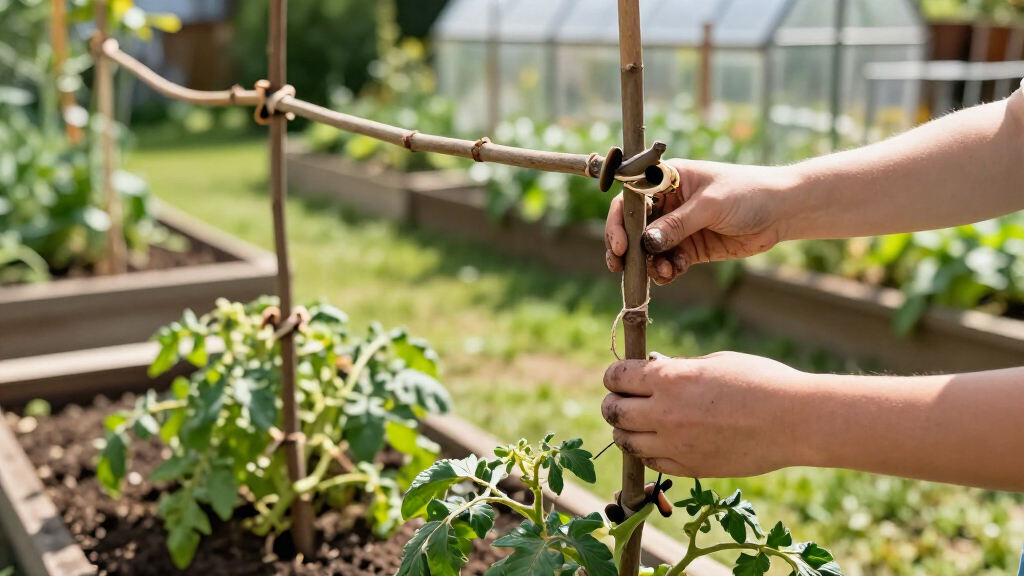
For a small plant, one or more chopsticks can be placed close to the stem; two or three can be joined with string to form a simple frame. Twine can also be run vertically, horizontally or in a grid between existing anchor points, depending on the climber. The report’s examples are practical suggestions, not reported results from a comparative trial.
“The trick is to match what you find to the kind of support your plant actually needs.”
— Amateur Gardening
As an affiliate, we earn on qualifying purchases.
Limits Depend on Plant Size
The report does not provide cost estimates, tests comparing these homemade supports with commercial products, or evidence that every option will work in all gardens. It also does not specify how long particular materials will last outdoors. The performance of a support will depend on the plant’s size and weight, the material’s condition, and how securely it is placed.
The examples are not presented as universal solutions. The source explicitly limits metal straws to young or delicate plants and twine frameworks to lightweight climbers. Gardeners will need to judge whether an improvised support can bear the plant’s growth and remain stable in local conditions.
As an affiliate, we earn on qualifying purchases.
Check Supports as Plants Grow
The next step for gardeners is to inspect plants that are beginning to lean or spread, then choose a support suited to the job. Secure ladders and branches, avoid damaged or sharp-edged materials, and tie stems loosely so they are not constricted. Recheck the setup as foliage and stems grow, especially where wind could put added strain on a structure.
Amateur Gardening offers the six ideas as a way to reuse available materials. It does not announce a product launch or a formal trial, and the source gives no further update or schedule.
As an affiliate, we earn on qualifying purchases.
Key Questions
What are the six homemade plant support ideas?
The report suggests an old ladder, an upside-down wire wastebasket, metal straws, wooden chopsticks, fallen branches and garden twine attached to an existing sturdy structure.
Can a metal straw support a large plant?
No. Amateur Gardening says a metal straw is best for a young or delicate plant or an individual stem. It says the straw is not substantial enough for a tall perennial or vigorous climber.
How should I use a wire wastebasket as a support?
Turn an open wire basket upside down over a spreading perennial and push its rim into the soil. Avoid a basket that is unstable, badly rusted or has exposed sharp sections.
How do I keep an improvised support from damaging a plant?
Use soft string, garden twine or plant ties, and secure stems loosely so they have room to thicken. Check supports as the plant grows and make sure the structure itself is firmly anchored.
Source: rss
Fall yard work Picks
leaf blowers
As an affiliate, we earn on qualifying purchases.